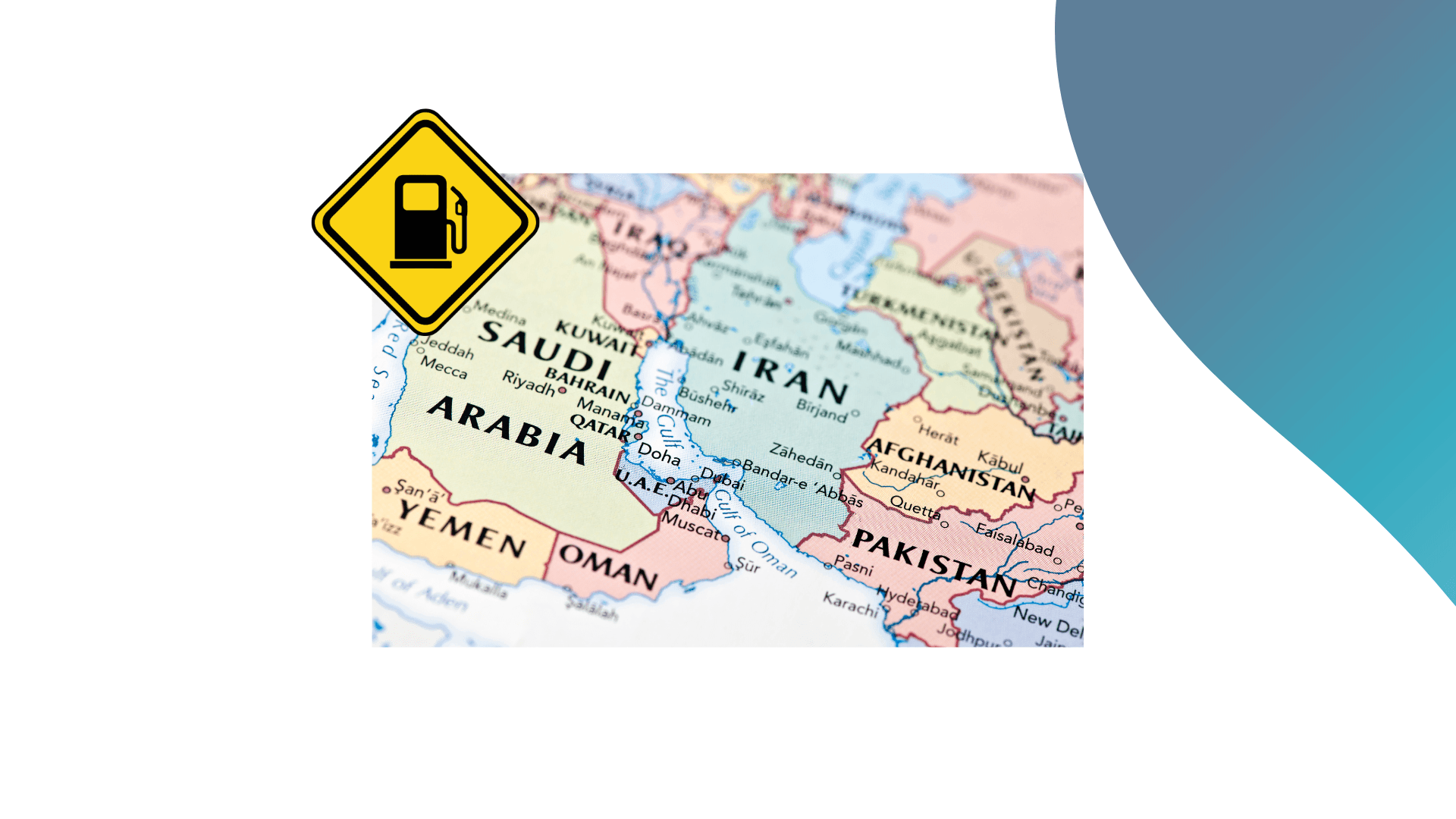
The Trigger: Qatar’s Ras Laffan
Qatar produced roughly 63 million cubic metres of helium in 2025, approximately one third of the 190 million cubic metres produced globally, according to the US Geological Survey. That concentration of supply in a single geography had long been flagged as a structural vulnerability and, on 2 March 2026, it became an active crisis.
Iranian missile strikes on Ras Laffan Industrial City caused three fires and wiped out approximately 17% of Qatar’s LNG export capacity, resulting in an estimated $20 billion in lost annual revenue over the next five years. Since helium is extracted as a byproduct of LNG processing, the damage to gas infrastructure immediately halted helium extraction. QatarEnergy declared force majeure, and there is currently no confirmed timeline for the facility’s restart. The damage is expected to take years to repair, with Qatar’s annual helium exports cut by 14% and some analysts projecting it will take the country around five years to regain lost capacity. Combined with the closure of the Strait of Hormuz to Western commercial shipping, approximately 30% to 38% of global helium output has been removed from the market as of March 2026. This sudden contraction has not only tightened supply but intensified competition among end users for the remaining volumes.
While the disruption is global, its effects are not evenly distributed. In an increasingly constrained market, access to helium is dictated less by necessity and more by the ability to secure and finance supply. High-value industrial users, particularly semiconductor manufacturers supporting AI and data centre expansion, are better positioned to absorb rising costs and lock in supply. By contrast, healthcare systems, which depend on helium for MRI scanners and other critical imaging technologies, face greater difficulty competing on price.
As a result, a symmetric supply shock is translating into asymmetric outcomes, where essential services risk being crowded out by higher-margin industries. The issue is therefore not only one of shortage, but of allocation, raising broader questions about resilience, prioritisation, and the societal value assigned to scarce resources.
Why Helium Is Irreplaceable in Chipmaking
Helium is used in several key stages of chipmaking, including cooling, leak detection, and precision manufacturing processes. As a noble gas, chemically inert and non-reactive, it is uniquely suited to the ultra-clean environments that advanced semiconductor fabrication demands so there is no practical substitute.
TSMC’s most advanced chip fabs consume roughly 500,000 cubic feet of helium per year. Unlike silicon, photoresist, or ultra-pure water, helium cannot be synthesised, recycled efficiently at scale, or substituted in most of its critical semiconductor applications. Most advanced fabs run helium recovery systems that recapture and purify 90-95% of the helium used in certain processes, but recovery rates vary sharply by application. Helium used in leak detection is effectively unrecoverable, and even a 5% loss rate across massive consumption volumes accumulates quickly.
The industry’s dependency has also been rising. In 2015, electronics and semiconductors accounted for roughly 6% of global helium consumption. By 2025 that share had grown to an estimated 10-12%, driven almost entirely by the expansion of EUV lithography.
Production Has Stalled, Logistics Have Collapsed
The supply shock operates on two levels simultaneously: on the production side, Russia’s Amur Gas Processing Plant, once projected to supply up to 25% of global demand, remains well below capacity as of early 2026, beset by explosions, technical setbacks, and Western sanctions. New exploration projects in Saskatchewan, Tanzania, and South Africa are years away from production. On the logistics side, the problem is equally severe. Helium must be transported in specialised cryogenic ISO containers maintained at -268.9°C, and the Strait of Hormuz is now effectively closed to Western commercial shipping, with major carriers rerouting vessels around the Cape of Good Hope. Roughly 200 specialised containers are reportedly stranded near the Strait of Hormuz and chip makers can typically store around six weeks’ worth of supply.
Working inventory at most fabrication sites amounts to approximately one week of supply, meaning production depends on continuous inbound shipments rather than stockpiles. Helium prices have doubled since the conflict began and are expected to rise further. They had already tripled from their 2015 levels before the current shock hit.
The Regions and Industries Most at Risk
The geography of chipmaking concentrates exposure heavily in the Asia-Pacific region. South Korea, home to Samsung and SK Hynix, imported 64.7% of its helium from Qatar in 2025. Taiwan faces comparable structural risk, relying heavily on Qatari imports to sustain foundry operations. South Korea’s Ministry of Trade, Industry and Resources has launched an investigation into supply and demand for 14 semiconductor materials and equipment types with high dependence on Middle Eastern sources. Bromine, used in circuit formation, is a further concern: South Korea sources 90% of its bromine imports from Israel.
The shortage also strikes enterprise storage through a separate mechanism. Every hard disk drive with a capacity of 10TB or higher is hermetically sealed with helium, which reduces internal turbulence and allows manufacturers to pack more platters into a single drive. This market was already severely constrained: Western Digital’s entire 2026 hard drive production is sold out, with 89% of its HDD revenue coming from cloud customers and prices up an average of 46% since September 2025. The helium shortage adds pressure on top of an already depleted supply stack.
The HDD shortage has also begun driving up SSD prices, as hyperscalers turn to solid-state alternatives. Smaller SSD manufacturers without their own memory production have seen price increases of a factor of two to three.
How Companies Are Responding
Procurement teams across the industry have moved quickly on several fronts:
Diversifying supply geographically
Air Liquide opened a new factory near the port of Taichung, Taiwan, on 27 March, specifically to diversify helium sourcing for Taiwanese chip makers. The Taichung facility sits near one of Taiwan’s three ports equipped to handle LNG and helium, and the company is actively assessing customer stockpiles while redirecting supply from other regions.
Pivoting to North American sources
Helium is now being sourced from the United States and Canada, with industry bodies concluding that alternative supply from these sources can ensure stable overall helium availability and prevent production shutdowns at major Taiwanese fabs. The United States produces 43% of global helium supply, making it the largest single producer and the primary alternative for buyers who had been reliant on Qatari imports.
Building domestic production capacity
In China, Guangdong Huate Gas has achieved mass production of 6N ultra-high-purity helium and secured ASML certification. China’s annual production capacity has reached approximately 1.2 million cubic metres, and several Chinese firms are developing recovery systems with reprocessing rates of up to 98%.
Redesigning tooling and processes
ASML and Applied Materials are redesigning next-generation tools to reduce per-unit helium consumption, with some newer etch and deposition chambers substituting nitrogen for non-critical cooling steps. These are incremental gains rather than systemic solutions.
Locking in long-term contracts
Because helium is typically sold through long-term contracts, buyers who lack existing agreements face significant difficulty accessing spot supply. Any new supplier must also pass through a rigorous purity qualification process before it can be used in semiconductor production.
Calls for strategic reserves
Taiwan’s semiconductor industry association has called for the country to maintain helium and other critical gases at levels comparable to national oil reserves, arguing that a semiconductor powerhouse cannot afford to treat strategic industrial gases as ordinary commodities.
The Structural Fragility Exposed
This is the fifth occasion since 2006 on which the world has faced a helium supply shortage. Each previous episode, triggered by plant outages, demand spikes, or geopolitical disruption, produced warnings about structural concentration risk that were not translated into durable policy or infrastructure investment.
The US Bureau of Land Management’s decision to wind down the Federal Helium Reserve traces back to the 1996 Helium Privatization Act, built on the logic of reducing government involvement in commodity markets. That logic looked reasonable in the 1990s, it looks considerably more questionable in 2026, when helium underpins the most important sector on earth. For now, most major chip companies are expanding safety inventories and have supply chain resilience strategies in place following the experience of the COVID-19 pandemic. If the conflict is resolved within four to six weeks, the industry does not expect significant supply disruption in key materials. However, a prolonged conflict risks cascading from helium into the broader petrochemical chain, affecting raw materials including methanol, polyethylene, and polypropylene, and compounding costs across chemicals and industrial materials more widely.
The helium crisis has exposed a tension at the heart of advanced manufacturing: the materials attracting the least public attention are often those on which the entire supply chain most critically depends. A gas better known for filling balloons turns out to be one of the most strategically irreplaceable substances in global technology production, finite, non-renewable, and with no viable synthetic alternative.
Background Reading and Additional Sources:
- Reuters / US News & World Report https://money.usnews.com/investing/news/articles/2026-03-26/helium-shortage-has-started-impacting-tech-supply-chains-execs-say
- Tom’s Hardware https://www.tomshardware.com/tech-industry/semiconductors/the-global-helium-shortage-is-a-direct-threat-to-chipmaking
- Tom’s Hardware https://www.tomshardware.com/tech-industry/qatar-helium-shutdown-puts-chip-supply-chain-on-a-two-week-clock
- Tom’s Hardware https://www.tomshardware.com/tech-industry/semiconductors/air-liquide-opens-taiwan-factory-as-helium-shortage-tightens-around-chip-makers
- HPCwire https://www.hpcwire.com/2026/03/27/global-helium-shortage-begins-to-constrain-high-density-compute-and-cooling-systems/
- Digitimes https://www.digitimes.com/news/a20260329PR200/2026-supply-market.html
- Al Jazeera https://www.aljazeera.com/economy/2026/3/26/helium-hitch-why-us-israel-war-on-iran-could-cause-mri-scan-delays


