
The Biggest Overhaul in a Decade
Public procurement accounts for roughly 14% of EU GDP, around €2 trillion of public spending every year. Yet the rules governing how that money is spent haven’t been fundamentally revised since 2014 and that’s about to change. The European Commission has confirmed a Public Procurement Act in its 2026 Work Programme, with a legislative proposal expected in Q2 2026. It’s the most significant overhaul of EU procurement law in over a decade, and it will affect every contracting authority, every supplier, and every organisation that touches the public sector across all 27 Member States. At a minimum, over twelve years of ECJ case law needs to be reflected in the regulations for procurement and these will form the basis for some of what is updated. It is worth noting at the outset that this reform does not extend to defence and security procurement, which remains governed separately under Directive 2009/81/EC and is subject to its own review process.
The Current Framework: Why It Needs Changing
The existing EU procurement framework rests on three core directives, all adopted in 2014:
- Directive 2014/24/EU – the general public procurement directive, covering the majority of contracting authorities
- Directive 2014/25/EU – covering utilities: water, energy, transport, and postal services
- Directive 2014/23/EU – governing the award of concession contracts
The current EU procurement framework rests on three core directives adopted in 2014: Directive 2014/24/EU (public sector), Directive 2014/25/EU (utilities), and Directive 2014/23/EU (concessions). These directives apply to contracts above specified financial thresholds. From 1 January 2026, the threshold for public works contracts is €5,404,000, with separate thresholds for supplies and services. Below these levels, national procedures apply, though they must still respect EU Treaty principles such as transparency and equal treatment.
Evidence increasingly suggests the framework is under strain. The European Court of Auditors’ Special Report 28/2023 found that competition for public contracts declined over the last decade and that key objectives of the 2014 reform, notably simplifying procedures and increasing participation, have not been fully achieved. Procedures have in fact become longer, while persistent challenges remain around SME participation, cross-border access, and administrative complexity.
What the Commission Is Proposing to Change
Further to updates arising from case law, the Commission’s stated ambitions for the new Act are broad. Drawing on President von der Leyen’s Political Guidelines (July 2024), her 2025 State of the Union address, and the Single Market Strategy adopted in May 2025, the reform is being built around four interconnected objectives.
Simplification
The Commission has explicitly acknowledged that the current rules are “overly complex.” The goal is to consolidate and streamline the three directives, and the wider body of procurement regulation, which extends to six directives, two regulations and numerous delegated acts, into a cleaner, more coherent framework. Reducing administrative burden on both buyers and suppliers is a stated priority.
Sustainability
Green Public Procurement criteria, currently largely voluntary, are expected to become mandatory in key sectors. Life-cycle costing, environmental performance data, and carbon metrics are set to move from “nice to have” to enforceable requirements. This aligns with related legislation already in motion, including the revised Construction Products Regulation and the Energy Performance of Buildings Directive.
Resilience
Supply chain security has become a central concern since Covid-19 and in the context of ongoing geopolitical disruption. The new framework is expected to give contracting authorities clearer tools to factor in security of supply, particularly for critical technologies, raw materials, and strategic products.
European Preference
Perhaps the most politically significant element: in her 2025 State of the Union address, President von der Leyen committed to introducing “made in Europe” criteria in public procurement. The Single Market Strategy confirmed this, the new Act will mainstream European preference criteria in certain technologies and strategic sectors, while seeking to ensure competitive tenders are maintained. Precisely how this will be squared with the EU’s WTO commitments under the Government Procurement Agreement remains one of the more complex legal questions the proposal will need to resolve.
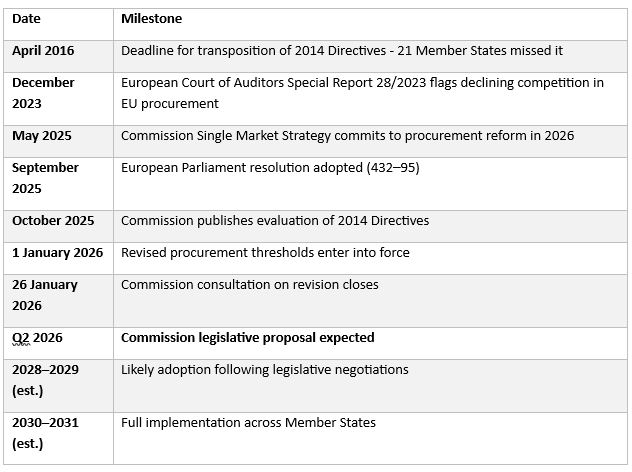
On 9 September 2025, the European Parliament backed these broad directions, adopting a resolution on public procurement by 432 votes in favour, 95 against, calling for reform to strengthen competitiveness, sustainability, resilience, and digitalisation.
The Legislative Process: Stage by Stage
Understanding where we are requires understanding what comes next. The journey from Commission proposal to law in force across all 27 Member States involves several distinct stages.
Stage 1 – Commission Proposal (Target: Q2 2026). The Commission tables its formal legislative proposal. The form of the instrument matters: a Regulation would be directly applicable without transposition, a Directive (the form used in 2014) would require Member States to translate it into national law. Most expert commentary assumes the Commission will opt for a Directive or recast package of Directives, though this has not been confirmed.
Stage 2 – Parliamentary and Council Scrutiny (Estimated: 12–36 months post-proposal). Under the ordinary legislative procedure, both the European Parliament and the Council must consider, amend, and agree on the text. For a file of this complexity and political sensitivity, this process rarely moves quickly. The average time from Commission proposal to adoption for EU legislation is around 20 months, but procurement reform is politically contested territory and may take longer.
Stage 3 – Adoption and Entry into Force. Once Parliament and Council reach agreement through trilogue negotiations, the text is formally adopted and published in the Official Journal of the EU. The Act enters into force 20 days after publication.
Stage 4 – Transposition (if Directive form: estimated 2 years). If the instrument takes the form of a Directive, Member States then have a deadline, typically two years, to write the new rules into their own national legislation. It is worth noting that when the 2014 Directives were adopted, 21 of the then 28 Member States failed to meet their transposition deadline of 18 April 2016, prompting formal infringement proceedings from the Commission. History may well repeat itself.
Realistic Timeline to Full Implementation. Working through these stages: if the proposal is tabled in Q2 2026, approved after approximately 24–36 months of legislative negotiation (placing formal adoption somewhere between late 2028 and mid-2029), and then transposed over a further two-year period, full implementation across the EU is unlikely before 2030 and quite possibly not until 2031. This extended timeline is important context, but should not be read as a reason for inaction.
What This Means for Organisations Now
The long legislative runway creates a window that organisations should use strategically and not passively.
For contracting authorities, the direction of travel is clear even if the final rules are not. Procurement strategies and standard contract terms built around pure cost competition and minimal sustainability requirements are already under pressure from existing obligations, and will face tightening requirements once the new Act is in force. Beginning to embed life-cycle costing, social value, and resilience criteria into procurement decision-making now will ease the transition considerably.
For suppliers to the public sector, the shift from voluntary to mandatory green criteria in key sectors will raise the bar for participation. Organisations that cannot demonstrate verifiable environmental credentials, not marketing claims, but documented metrics, will find themselves at a growing disadvantage as contracting authorities begin anticipating the new framework.
For those operating in strategic sectors, defence, critical raw materials, energy, digital infrastructure, the introduction of European preference criteria will reshape competitive dynamics. Understanding where your supply chain sits relative to those criteria, and engaging with industry bodies and sector associations during the legislative process, is prudent.
The Commission’s public consultation on the revision ran until 26 January 2026 and is now closed. However, the legislative process itself creates multiple further opportunities for input, through Parliamentary committee scrutiny, Council working group discussions, and the national transposition processes that will follow adoption.
Key Dates at a Glance
Background Reading and Additional Sources:
- European Parliament Legislative Train Schedule: Public Procurement Act
- European Commission, 2026 Work Programme (COM(2025)870), 21 October 2025
- European Commission, Single Market Strategy (COM(2025)500), 21 May 2025
- European Commission, Evaluation of Directives 2014/23, 2014/24, 2014/25 (SWD(2025)332), 14 October 2025
- European Parliament resolution on public procurement, 9 September 2025
- President von der Leyen, Political Guidelines 2024–2029, 18 July 2024
- President von der Leyen, State of the Union address, 10 September 2025
- European Court of Auditors, Special Report 28/2023, 4 December 2023
