
Panel arrangements, often referred to as frameworks, are designed to make buying faster and more predictable. Suppliers are pre-qualified, commercial terms are agreed in advance, and buyers have a clear and compliant route to market. Used well, this structure reduces transaction costs and allows contracting authorities to focus on delivery rather than repeated procurement processes.
The risk emerges when speed turns into routine. Over time, the repeated use of the same suppliers through panels can drift into habitual direct award, not because competition is unavailable, but because reopening it starts to feel unnecessary. What begins as an efficiency tool can become a default sourcing model, with competition treated as an exception rather than a normal step. Even within a closed group of pre-qualified suppliers, buyers are still expected to test value for money and wherever proportionate, to create competitive tension at call off stage. In practice, panels can function as marketplaces where multiple capable suppliers are regularly invited to compete for work. Or they can become shortcuts, where a familiar supplier is repeatedly selected, and the panel serves primarily as a compliance wrapper around what is effectively sole sourcing.
Australia’s panel model in context
Australia’s extensive use of panel arrangements reflects a procurement system that is both mature and deliberately pragmatic. Panels are deeply embedded across Commonwealth departments because they address a persistent administrative reality: demand for professional and advisory services is frequent, variable in scope, and often time-sensitive. Running a full open tender for each engagement would be disproportionate, slow and costly, both for government buyers and for the supplier market. Panels provide a structured solution to this problem by front-loading qualification, due diligence, and baseline commercial terms, while keeping engagement flexible at the point of need. At a design level, Australian panels function as controlled marketplaces rather than static supplier lists. Entry conditions are explicit, capability thresholds are clearly defined, and suppliers understand both the eligibility requirements and the expectations that follow appointment. This upfront clarity reduces transaction costs on both sides. Buyers avoid repeated compliance checks and suppliers avoid repeated qualification exercises. In complex service categories such as management consulting, ICT advisory and specialist professional services, this model allows procurement effort to be concentrated where it adds most value, namely shaping requirements, evaluating competing approaches, and also managing delivery risk.
The policy intent behind panels is not administrative convenience alone. The Commonwealth Procurement Rules are explicit that panel membership does not weaken the obligation to demonstrate value for money. Competition is not treated as optional or symbolic, but as a primary mechanism for testing price, quality, and delivery capability at the point of engagement. Panels are therefore designed to preserve contestability over time, not to replace it. The conceptual logic is sound and closely aligned with international best practice: qualification happens once, competition happens often.
Where Australia becomes particularly instructive is not in the elegance of the model, but in its scale and longevity. Panels have been used extensively, across many departments, and over long periods. This creates a large and observable data set on how the tool behaves in practice, not just how it is supposed to behave on paper. As a result, it becomes possible to distinguish between formal compliance and economic outcomes. One can observe whether competition is actually being reopened, how supplier concentration evolves over time, and whether incumbency advantages begin to dominate call off behaviour. The visibility is a structural strength, as it allows policymakers, auditors, and commentators to identify patterns that would otherwise remain hidden. Where panels are used as intended, they operate as active marketplaces, with multiple suppliers regularly invited to quote and with outcomes that shift over time. Where they drift, the evidence shows a different pattern, repeated direct engagement with the same supplier, declining quote rates, and a gradual narrowing of effective competition. Importantly, these outcomes often remain formally compliant with the rules, which is precisely why transparency matters. The system makes it possible to see when a lawful tool begins to produce weaker competitive outcomes than its designers intended. Australia’s experience provides a rare opportunity to observe procurement governance in motion. The Australian system makes those dynamics visible, which is itself a form of institutional maturity. Other jurisdictions can learn not only from what Australia gets right in principle, but from what its data reveals about how easily efficiency tools can drift when competitive behaviour is not actively reinforced.
Why transparency helps
Publishing information on how many suppliers were approached for each call off is a useful first step, because it makes visible whether panels are functioning as competitive marketplaces or slipping into habitual direct awards. Once this data is public, patterns become harder to ignore and easier to challenge, both internally and through external oversight.
If a team is rewarded for cycle-time alone, the system will predictably drift towards direct award by default. Speed becomes the primary success metric, while the quality of market engagement quietly drops out of view. Over time, buyers stop asking whether competition is proportionate or achievable and start assuming that using a single supplier from a panel is the safest and quickest option. The same risk appears in assurance and audit processes. If checks focus only on whether a compliant panel or framework exists, rather than on how it was actually used, then poor competitive practice can pass unchallenged. The paperwork is technically correct, but the underlying market behaviour is not. Fewer suppliers are approached, incumbent advantage grows, and panels that were designed to maintain contestability gradually narrow into de facto single supplier routes.
The result is not an immediate breach of procurement rules, but a slow erosion of value for money, innovation, and supplier diversity.
Ireland: the same tool, with fewer signals
Ireland makes extensive use of central frameworks established by the Office of Government Procurement, which are designed to give contracting authorities faster access to pre-qualified suppliers under agreed terms. Call offs are typically made either through mini competition, where all or a defined subset of framework suppliers are invited to compete, or through direct drawdown, sometimes structured via a cascade mechanism. In formal terms, this means the architecture already supports competition and proportional reopening of the market at call off stage.
However, the way this architecture is used is harder to assess from the outside. While Irish procurement rules and OGP guidance clearly set out when mini competition is required and when direct drawdown is permitted, the resulting data trail is often fragmented. Information on how many suppliers were invited to quote, whether a mini competition was genuinely reopened, or whether a cascade was actively tested is not consistently published in a way that allows easy scrutiny by suppliers, policymakers, or oversight bodies. Contract award notices will typically confirm that a call off has been made under a framework or Dynamic Purchasing System, but they do not always indicate whether multiple suppliers were approached, how competition was structured, or whether alternatives were considered. In the case of a DPS, although all admitted suppliers may be invited to compete, the composition of the supplier pool is not always transparent during the lifecycle of the system. Unlike a closed framework, it is therefore not always visible whether ten suppliers or thirty were actually eligible to bid at the point of call off.
As a result, it can be difficult to distinguish between frameworks operating as dynamic marketplaces and those functioning more as administrative shortcuts. This does not imply noncompliance, but it does limit visibility into buyer behaviour and makes it harder to identify patterns over time. This risk is therefore not one of rule breach but of signal loss. Without clear and accessible indicators showing when and how competition is being reopened, neither the market nor central oversight functions can easily assess whether frameworks are delivering sustained value for money, supplier access, and competitive tension. Over time, this opacity can allow perfectly lawful but weak competitive habits to embed themselves, particularly where speed, familiarity, or risk aversion become the dominant drivers of procurement decisions.
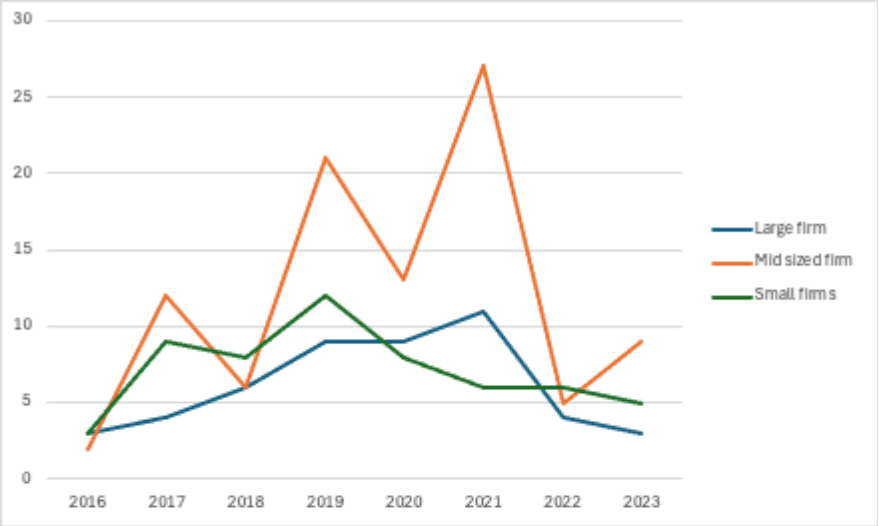
Mini-competition awards for accounting services from 2016-2023.
Source: records published by the OGP and by the open government data portal.
What good governance looks like across systems
Across different procurement systems, framework and schedule agreements are designed to deliver efficiency without diluting competition. The common governance principle is clear: where multiple suppliers are appointed, buyers must actively preserve competitive tension at the point of call off unless objective conditions justify otherwise. In the UK, the Crown Commercial Service sets this expectation explicitly. Where a framework agreement includes more than one supplier and does not establish all terms governing future contracts, contracting authorities are required to run a further competition, often referred to as a mini competition. All suppliers capable of delivering the requirements within the relevant lot must be invited to bid. Direct awards are only permissible where the framework terms are sufficiently precise to determine the best supplier objectively, or where the framework itself expressly allows for a ranked or rotational award mechanism. The governance focus is on transparency, equal treatment, and auditability of the award decision.
French public procurement doctrine follows a similar logic, even though the legal structure and terminology differ. Guidance under the Code de la commande publique distinguishes clearly between execution methods for accords cadres. Where an agreement is concluded with multiple economic operators, contracting authorities are generally expected to reopen competition for call offs unless all contractual terms, including pricing and performance conditions, were fixed at the outset. Reopening competition is treated as a safeguard to ensure value for money and prevent exclusivity emerging during execution. Authorities are expected to document the rationale where competition is not reopened, particularly for higher value or strategically sensitive purchases.
In the United States, governance around multi supplier purchasing vehicles arrangements is similarly anchored in competition principles. Under the GSA Multiple Award Schedule, ordering activities are generally expected to seek competition at the order level. The Federal Acquisition Regulation requires that, when placing an order under a multiple award schedule, contracting officers normally invite all capable schedule holders to compete. Limiting the competition to fewer suppliers is permitted only in defined circumstances and must be formally justified and recorded. Exceptions exist, such as urgent need or unique capability, but these must be justified and recorded. The emphasis is not merely on procedural compliance, but on maintaining competitive pressure throughout the life of the schedule.
These systems reflect a shared governance norm. Multi supplier arrangements are not a license for convenience purchasing. They are conditional tools, designed to balance speed with discipline.
Here is a practical comparison of governance levers:
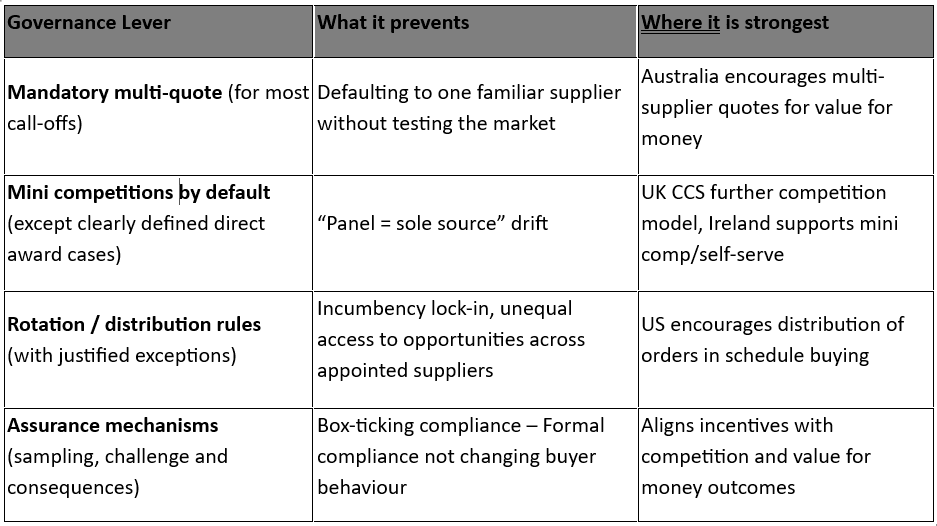
A simple governance blueprint for panel owners
If you run a panel, the best results usually come from combining three mechanisms:
- Mandate multi quote approaches for low to mid value call offs, with a clearly defined and documented exception route. Requiring buyers to seek quotes from more than one panel supplier, unless there is a justified reason not to, helps maintain competitive tension at the operational level. The exception process matters as much as the rule itself. It should be simple, proportionate, and auditable, allowing direct award where genuinely justified while preventing convenience from becoming the default rationale.
- Use periodic mini competitions for repeat requirements or where concentration begins to rise. Even where drawdown or cascade mechanisms are allowed, reopening competition at defined intervals helps test whether pricing, quality, and delivery remain aligned with market conditions. This is particularly important in categories where the same suppliers are repeatedly selected, as it helps prevent incumbency advantage from hardening into market exclusion.
- Align assurance and incentives with competitive behaviour, not just process compliance. This means tracking how panels are actually used in practice, including how often competition is reopened, how supplier share evolves over time, and how frequently exceptions are invoked. Publishing aggregate approach rates and requiring proportionate sign off where competition is not run shifts the focus from simply proving that a framework exists to demonstrating that it is delivering ongoing value for money.
Taken together, all these mechanisms allow panels to operate as intended. As structured marketplaces that balance efficiency with sustained contestability.
Background Reading and Additional Sources:
Contracts for Mini-Competitions and Standalone Awards 2022 Q4
https://data.gov.ie/dataset/contracts-for-mini-competitions-and-standalone-awards-2022-q4
Commonwealth Procurement Rules
https://www.finance.gov.au/government/procurement/commonwealth-procurement-rules
How to buy through direct award https://www.crowncommercial.gov.uk/how-to-buy/frameworks/direct-award
Procuring from a Panel – Panels 101 https://www.finance.gov.au/government/procurement/buying-australian-government/procuring-panel-panels-101
Business Management and ICT Consultancy /Consultant Services https://www.gov.ie/en/office-of-government-procurement/ogp-frameworks/business-management-and-ict-consultancy-consultant-services
PUBLIC PROCUREMENTGUIDELINES FOR GOODS AND SERVICES https://www.fingal.ie/sites/default/files/2022-09/OGP%20Public%20Procurement%20Guidelines%20for%20Goods%20and%20Services.pdf
How to buy through further competition https://www.crowncommercial.gov.uk/how-to-buy/frameworks/further-competition
Les accords-cadres – Direction des Affaires juridiques https://www.economie.gouv.fr/files/files/directions_services/daj/media-document/FT33_Les_accords_cadres.pdf
Ordering procedures for supplies, and services not requiring a statement of work. https://www.law.cornell.edu/cfr/text/48/8.405-1
