
On 9 September 2026, the European Commission adopted its long-awaited proposal for a Public Procurement Act, a single Regulation intended to replace the three directives (on public contracts, utilities, and concessions) that have governed EU public purchasing since 2014, alongside sector-specific procurement provisions scattered across other legislation. The proposal replaces the three existing Directives on public contracts and concessions with a single, directly applicable Regulation, while also consolidating procurement provisions currently scattered across sector-specific legislation, aiming to reduce divergences arising from national transposition and ensure more uniform application of procurement rules across the Union.
The Commission’s own reference for the file is COM(2026) 590, under the ordinary legislative procedure 2026/0265 (COD), and the proposal was presented alongside a companion “Innovation Act” on the same day, marking the second anniversary of the Draghi competitiveness report. The measure that has drawn the most attention, and the most controversy, is a new ”European preference”mechanism, which is the part most people mean when they refer to “Buy European.”
Why it exists: the Draghi context
The proposal is explicitly framed as industrial policy as much as procurement reform. The Mario Draghi report on EU competitiveness centred on the idea that the EU needed to modernise its economy and reduce strategic dependencies on China and the United States, and the Commission presented this reform on the report’s two-year anniversary, having by its own account implemented only around 15% of Draghi’s recommendations so far. Executive Vice-President Stéphane Séjourné, who holds the Commission’s Prosperity and Industrial Strategy portfolio, presented the package and made the industrial rationale explicit, arguing, in effect, that the EU should not be afraid to favour its own companies over foreign competitors in strategic sectors.
What the Regulation changes overall
Beyond the preference mechanism, the proposal makes several structural changes:
- Fewer, simpler procedures: The current patchwork of processes would be replaced by two main routes: an “open” procedure (any business can bid) and a “dynamic” procedure (an ongoing pool of pre-qualified bidders), plus a separate “innovation” track for governments developing entirely new solutions.
- More room to negotiate: Public buyers would be able to negotiate on price, delivery terms and specifications, moving the process closer to commercial procurement practice.
- Quality over lowest price. Quality criteria would have to count for at least 30% of the award score, rising to 50% for labour-intensive contracts such as construction or services. A contract is defined as “labour-intensive” where labour costs would normally account for at least half its value, and under the Commission’s proposed “comply or explain” principle, an award based on price alone would only remain possible where quality is already secured through the technical specifications or contract conditions, with any departure justified in the competition notice.
- Lighter burdens for SMEs: The package would curb disproportionate turnover or track-record requirements that can exclude capable smaller businesses before their bid is even assessed, andwould make digital records reusable across the procurement system to reduce repeated requests for information already supplied.
- Estimated savings: The Commission expects roughly €80 million of savings to benefit public buyers and €570 million to benefit businesses.
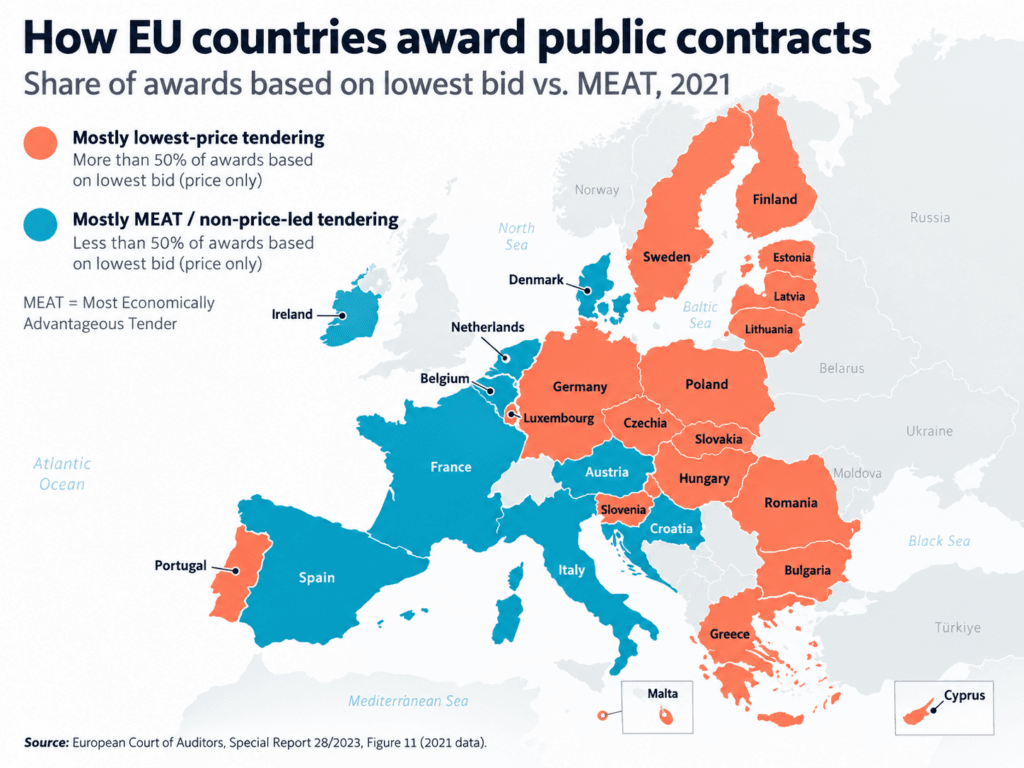
Orange indicates countries where more than half of contract awards were based on lowest price alone; blue indicates countries where the majority incorporated criteria beyond price, reflecting broader use of the most economically advantageous tender (MEAT) approach.
The “European preference” mechanism
This is the operative part of ‘Buy European.’ It sits in Article 73 of the Regulation, and gives public buyers a toolkit rather than a single blanket rule:
- Restrict participation to EU suppliers and “covered” partners (see below).
- Impose origin requirements on all or part of a contract’s value.
- Give a scoring advantage to bids with a higher share of qualifying EU or covered content, either as bonus points, or as a notional price reduction applied only for evaluation purposes, not to the amount actually paid.
- Reject bids outright where less than 50% of a tender’s estimated value consists of EU or covered-partner content, for large or strategic contracts.
These preferences would have to be disclosed in the procurement documents in advance, a public buyer could not introduce an undisclosed origin test after bids arrived to favour a chosen supplier. The proposal also allows restrictions linked to security of supply, and gives the Commission a role where a trading partner fails to provide the treatment expected under its commitments.
Who qualifies for preference
The preference is not limited to EU-based firms. Suppliers from countries covered by the WTO Agreement on Government Procurement (GPA), and from partners whose trade deals with the EU contain a procurement chapter, would also qualify, and the Commission could strip that status from a partner country by delegated act if it excludes European firms from its own tenders. China is not a party to the WTO GPA and has no EU trade agreement covering procurement, so Chinese suppliers could be excluded where preference clauses are activated, a Commission official has already cited an April 2026 precedent in which a Chinese train manufacturer, CRRC Tangshan, was barred from a Lisbon-area project over state-subsidy concerns. The UK, Norway, Switzerland and Canada retain access to EU procurement markets through the WTO GPA and, in the UK’s case, the post-Brexit Trade and Cooperation Agreement, so firms from those countries are not targeted by the restriction.
An important caveat: scope is contested
Reporting is not fully consistent on how broadly the preference applies, which matters for anyone advising clients on exposure:
- Some legal commentary (e.g., Reed Smith) frames it as a general toolkit available to public buyers across procurement generally.
- At the launch, Séjourné specifically framed the preference around “strategic public services”, energy, water, railways, ports, airports and postal services, sectors traditionally covered by the separate utilities directive.
- Trade-law analysis (MLex) states more narrowly that the Act itself would not impose a blanket “buy European” rule, but would establish common horizontal rules for preferences that are required elsewhere, under sector-specific EU legislation.
Given these are three different characterisations of the same clause, this is worth confirming directly against the published legislative text (and, once available, the Commission’s official Q&A) rather than relying on any single secondary source.
The numbers: how big is EU public procurement?
Cited figures vary somewhat by source and reference year, which is worth flagging rather than picking one number to state as definitive:
- EU Today cites a Commission estimate of the market’s 2025 value at approximately €2.5 trillion, or about 15% of EU GDP.
- German reporting citing the Commission directly puts annual public-sector contract value at around €2.6 trillion.
- Other reporting rounds this to roughly €2 trillion, or close to 14% of the bloc’s economic output.
The differences likely reflect different reference years and whether sub-threshold/national procurement is included.
The political fault line
The debate over European preference in late 2025 and early 2026 revealed a disagreement not simply over whether to support European industry, but over how to balance domestic production, economic security and international trade. France favoured a stricter Made in Europe approach, while Germany advocated a more flexible Made with Europe model that included trading partners and reserved preferential treatment for critical strategic sectors as a last resort. This distinction suggests different understandings of industrial resilience: one placing greater emphasis on production within Europe, the other allowing a larger role for cooperation with external partners.
The practical tension is that narrower eligibility rules could direct more publicly supported demand towards European production, but could also exclude suppliers and components on which European manufacturers depend, making the geographical definition of European preference consequential for both costs and investment decisions. These concerns were reflected in a joint paper presented on 8 December 2025 by the Czech Republic, Estonia, Finland, Ireland, Latvia, Malta, Portugal, Slovakia and Sweden, which warned that broadly applied preferences could raise prices, weaken competition and innovation, and disrupt supply chains. Rather than rejecting all preferential measures, the nine governments argued that they should be targeted, time-limited and supported by an assessment demonstrating that adequate alternatives were unavailable. Their position therefore left room for intervention while challenging the assumption that favouring European production would necessarily strengthen European competitiveness. Swedish Prime Minister Ulf Kristersson reinforced this argument in his February 2026 interview with the Financial Times, maintaining that European businesses should compete through quality and innovation rather than depend on protection from international competition. His intervention highlighted the distinction between helping firms develop competitive capabilities and shielding firms that lacked them.
British objections added a cross-border production dimension: at the February 2026 UK-EU Partnership Council meeting, the UK warned that an excessively restrictive definition could increase costs and damage deeply integrated supply chains, framing cooperation with Britain as compatible with, rather than contrary to, European economic security. Separately, Washington opposed potential restrictions on US suppliers under the revision of the EU’s defence-procurement directive, illustrating how European-preference measures could also generate disputes over allied access to defence markets. Taken together, these positions suggest that the central disagreement concerned the boundaries and conditions of intervention rather than a straightforward choice between supporting industry and maintaining open markets: which sectors warranted preferential treatment, how long it should last, which partners should qualify, and how any gains in domestic capacity would compare with the costs of restricting competition and existing supply relationships.
Legislative status and timeline
This is the point that matters most for anyone briefing clients or colleagues: nothing in this article is current law.
- The proposed regulation has not become law. Its provisions must be negotiated by the European Parliament and member states before public buyers can use the new framework.
- The proposal must clear the European Parliament and the Council of the EU under the ordinary legislative procedure, which has no fixed first-reading deadline, so the timing of final adoption is genuinely uncertain and the provisions described here may still change materially.
- Once adopted and published, the Regulation would apply two years after publication, a transition period intended to give businesses and public purchasers time to prepare, and, as a Regulation rather than a directive, it would not require national transposition and would be binding and directly applicable in all Member States, though states may still need to adjust ancillary national rules.
Given that timeline, even in an optimistic adoption scenario, the “Buy European” rules are unlikely to be operative before 2028–2029 at the earliest, and could slip further, the Commission’s own original target of Q2 2026 for this same proposal had already slipped to September before adoption.
What this means in practice for procurement professionals
For contracting authorities and suppliers alike, the sensible posture right now is preparation, not action:
- Non-EU suppliers and subcontractors should start mapping their EU-content exposure now, particularly for firms relying on Chinese-origin goods, services or components in bids likely to fall into “strategic” or sensitive categories.
- Bid strategy generally will need to shift: with quality criteria locked at 30-50% of the score, lowest-price-only bidding will become harder to justify or win.
- Contracting authorities will need internal guidance on if and when to activate preference clauses, since the mechanism appears to be discretionary/toolkit-based rather than automatically imposed, pending clarification of the scope question above.
- Watch the trilogue process closely, the France/Germany, and broader “cautious nine” versus industrial-policy camp split, means the final text agreed by Parliament and Council could look quite different from the Commission’s September proposal.
Background Reading and Additional Sources:
European Commission – Public Procurement Act overview page: https://single-market-economy.ec.europa.eu/single-market/public-procurement_en
CMS Law (Germany), “Public Procurement Act: EU-Kommission reformiert Vergaberecht”: https://cms.law/de/deu/legal-updates/public-procurement-act-eu-kommission-reformiert-vergaberecht
MLex, “EU’s procurement overhaul sets framework for ‘European preference'” (9 Sept 2026): https://www.mlex.com/mlex/articles/2522990
Brussels Signal, “Procurement reopens split over ‘European preference'” (9 Sept 2026): https://brusselssignal.eu/2026/09/brussels-procurement-plan-reopens-eu-split-over-european-preference/
EU Today, “Brussels proposes European preference in €2.5tn public procurement market” (10 Sept 2026): https://eutoday.net/eu-public-procurement-act-european-preference/


